Aimtec Automation: automation technology
decoration
Aimtec Automation

Automation technology

Choose the most suitable technologies for your operation

Conveyor systems, robotic cubic warehouses, autonomous mobile robots, shelf stackers, sorters… the possibilities are endless, and every situation asks for a different combination. In the end, all the parts must fit together precisely. Like a well-oiled machine. Choosing the right technology is not a matter of trends, but of your operation’s specific parameters:
background arrows
  • Type, dimensions and weight of the unit being handled
  • Required performance and the ability to deal with operational peaks
  • Length and complexity of routes and number of connections
  • Flexibility of operation and the need to scale the solution over time
  • Available space, construction conditions and operating environment
  • Method used for connecting the technologies to control systems

A whole that works

Process logic

Process logic

No gaps, no blind spots – the process is covered from putaway out to shipping.

Engineering and technical integration

Engineering and technical integration

Interfaces among all the technologies are taken care of, and the premises’ building and operating conditions are addressed as well.

System integration and management

System integration and management

New and existing technologies lie under one digital layer – connected and managed in real time.

Automation technology

Identification
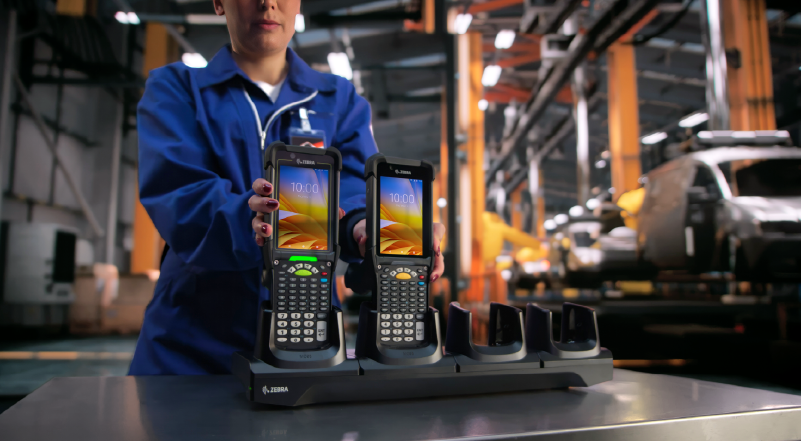
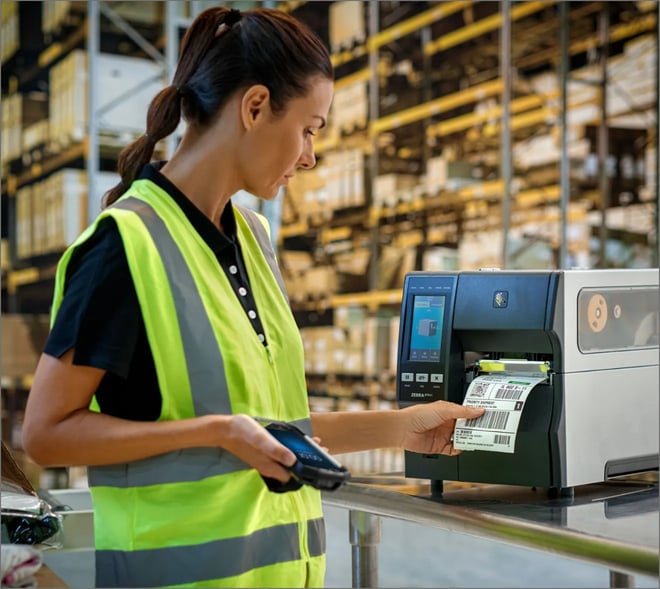
Industrial identification, including RFID, mobile terminals, code readers and label printers, is essential for automating logistics in manufacturing and logistics companies. It enables fast and accurate real-time data collection, increasing efficiency, traceability and control over the flow of goods. These technologies reduce errors, speed up processes and help optimise costs, making them a key element for modern, fully automated logistics.
I’m interested
Identification

Mobile terminals

Mobile terminals enable workers to collect, control and share data in the field or in the warehouse. Thanks to their online connectivity, they provide instant access to inventory and order information, thereby increasing logistics processes’ efficiency, accuracy and fluidity.

Scanners

Barcode scanners are used for fast and error-free retrieval of product, inventory and goods-movement information. They significantly speed up warehouse operations, reduce errors and ensure accurate traceability throughout the supply chain.

Wearable equipment

Wearable technologies such as finger scanners and voice-controlled devices allow workers to work hands-free. They speed up picking operations, improve work ergonomics and support efficient data collection without interrupting work processes.

Industrial printers

Industrial printers are used to produce durable labels, barcodes and RFID tags. They enable reliable tagging of products and assets, which is crucial for accurate identification, tracking of goods movements and efficient management of logistics processes.

Tablets

Rugged industrial tablets provide a clear interface for managing warehouse and manufacturing operations. They enable easy access to data, process visualisation and real-time communication, supporting fast decision-making and better work coordination.

Machine vision

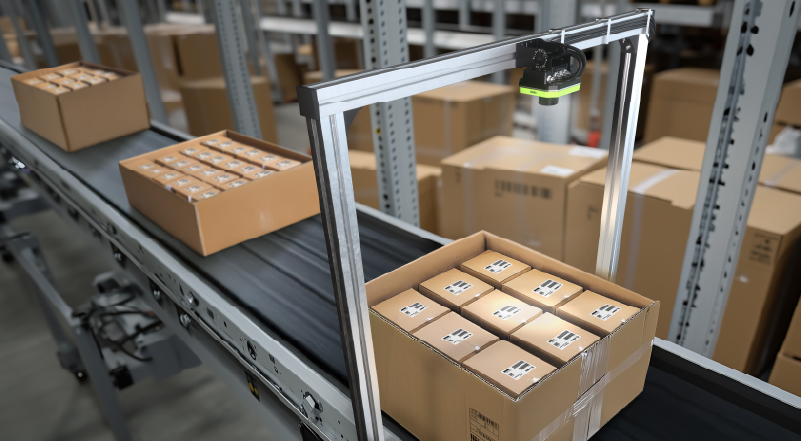
Machine vision uses cameras and advanced algorithms to automatically identify and inspect objects. It enables non-contact code reading, quality control and material flow control, thereby increasing the accuracy, speed and level of process automation.

Handling and transport

Warehouse handling and transport involves the movement of goods, pallets and KLT boxes between processes such as receiving, storage, picking and dispatch. Conveyors, robotic systems (AMR and AGV) and other automation technologies are used for this. The aim is to ensure smooth material flow, high performance and minimised downtime. A properly designed system significantly increases efficiency and reduces operating costs.
I’m interested
Handling and transport

AMR

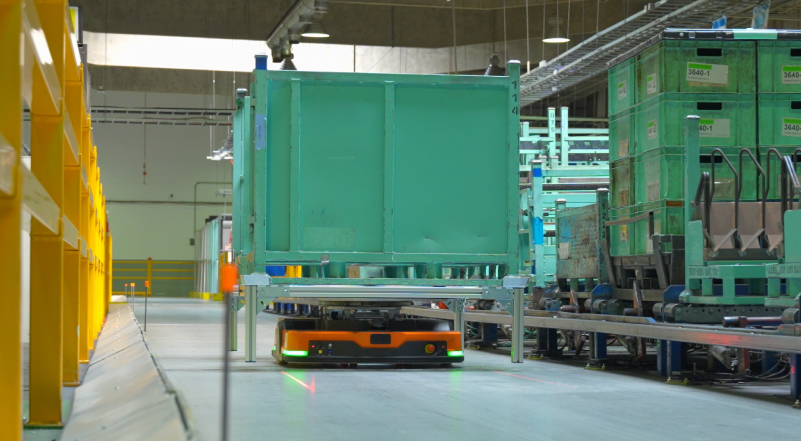
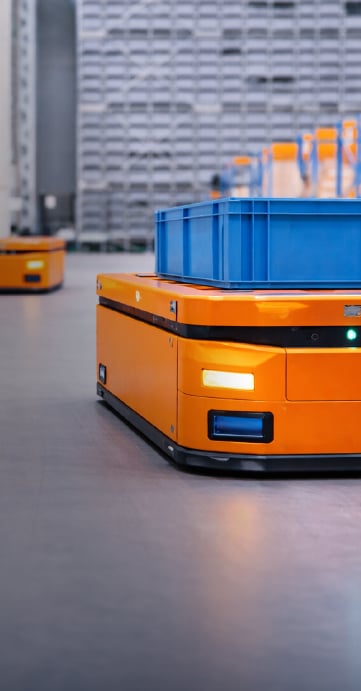
AMRs (Autonomous Mobile Robots) are used to transport goods in a warehouse without the need for a fixed route. Using sensors and space mapping, they navigate autonomously and avoid obstacles. They help move materials between warehouse zones or transport goods to workers using the “goods-to-person” principle. Compared to AGVs, they are more flexible and adapt more easily to changes in the warehouse.

AGV

AGVs (Automated Guided Vehicles) are designed to transport goods in a warehouse or production facility. They move along predefined routes marked out by, for example, magnetic tape, wires or signs. They have less flexibility than AMRs but are very reliable and suitable for stable, repetitive processes. They are mainly used for regular transport of pallets and materials between fixed points.

RGV

An RGV (Rail Guided Vehicle) is an automated vehicle that moves on a fixed track (an ordinary rail or a guide rail) inside a warehouse or production facility. It is used to transport goods or pallets between different levels or sections of a warehouse. The fixed track makes it very accurate and reliable, but it lacks the flexibility of an AMR. It is mainly used in automated warehouses with a high but fluctuating frequency of transport and repetitive routes.

Conveyors

Conveyors are used for transporting pallets, crates or KLT boxes and ensure high performance and a constant flow of goods. They minimise the physical labour of workers and speed up handling. Compared to AMRs, they have the advantages of constant speed and capacity on repeated routes, reliability and suitability for continuous operation with high volumes of goods or materials.

Light conveyor systems

Light conveyor systems are used for automated transport of small loads – especially KLT boxes, crates or single items. They move on a simple track (a rail or suspension system) and allow fast and flexible transport between workplaces. Compared to conventional conveyors, they have a lower initial cost and smaller space requirements. They are suitable for operations with smaller volumes of goods or a structured warehouse layout.

Automatic sorting systems (sorters)

Automatic sortation systems are used to quickly and accurately sort goods by destination, order or route. They use various technologies, such as 3D sorters, cross-belt or tilt-tray sorters, and are often linked to conveyors. Alongside high performance and consistent frequency, they minimise sorting errors. They are key to efficient handling in large warehouses and distribution centres.

Automated warehouses

The automated warehouse is the heart of your logistics system. The core element in its design is the range of packaging types handled – it can be a pallet warehouse, a KLT box warehouse, a box warehouse or a combination of these. The common denominator of all automation projects is packaging variability and quality.


The dynamic development of technology today means that individual systems are increasingly intertwined and combined to create hybrid solutions.
I’m interested
Automatic warehouse

Shuttle systems (pallets, KLT boxes and boxes)

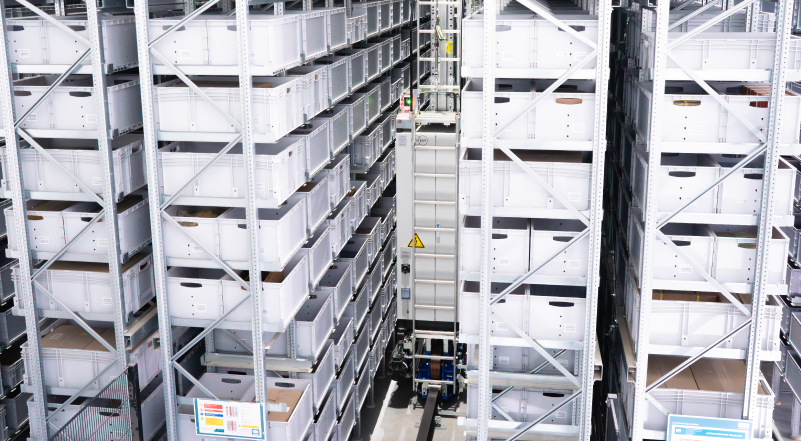
Shuttle systems for KLT boxes and pallets are automated storage systems in which small trolleys (shuttles) move along rails in rack channels to store and pick goods. They move horizontally among positions and work with elevators or conveyors to provide vertical transport among levels. These systems enable very fast and efficient handling of KLT boxes and pallets at high storage densities. Shuttle systems offer performance at high storage heights, as well as redundancy to ensure continuous operation even if part of the system fails.

Stackers (pallets, KLT boxes and boxes)

Stackers for KLT boxes, miniload boxes and pallets are industry-proven automated storage systems in which the stacker moves in the aisles between shelves to store and retrieve goods. Their movements are in both the vertical and horizontal directions, allowing precise stacking in specific positions, including double-deep and multideep solutions for higher storage density. These systems are suitable for handling a variety of carrier types, from small KLT boxes to pallets at high storage heights.

AMR storage systems (pallets, KLT boxes and shelves)

AMR warehouses are automated systems where autonomous mobile robots move goods or shelves around the warehouse floor and transport them to picking stations. Such a system enables efficient use of space by allowing flexible shelf arrangements and free movement of robots between them. Thanks to its automation, high performance, fast picking, safe handling of goods and easy scalability can be achieved – the warehouse capacity can be gradually expanded by adding more robots or storage points.

Cubic systems (KLT boxes)

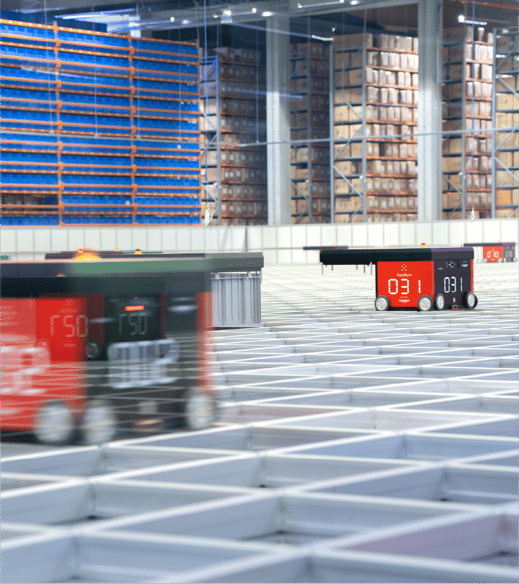
Cubic systems (e.g. AutoStore) are automated storage systems in which boxes are placed in a dense grid above each other, with robots moving along the top of the structure to pick the boxes from above. The system only works with boxes (e.g. KLT) and is not designed for pallet handling. It allows for very high storage density and efficient use of space by storing goods in a “cube” structure. The cubic system offers high performance, flexibility and also easy scalability as it can be gradually expanded with additional robots or storage capacities.

Carousel systems (KLT boxes, boxes)

Carousel systems are automated storage systems where boxes (e.g. KLT) are stored on rotating vertical or horizontal belts. The system brings the desired box directly to the picking station, minimising operator movement. The compact layout allows efficient use of space and high storage density. The automation used ensures fast picking, safe handling and easy scalability – the system can be expanded with additional modules as required.

Robotics

In intralogistics, robotics is the use of industrial and collaborative robots to handle goods inside the warehouse. Robots increase efficiency when moving products, pallets or boxes, while eliminating manual, ergonomically unsuitable work by staff.
I’m interested
Robotics

Palletising and depalletising solutions

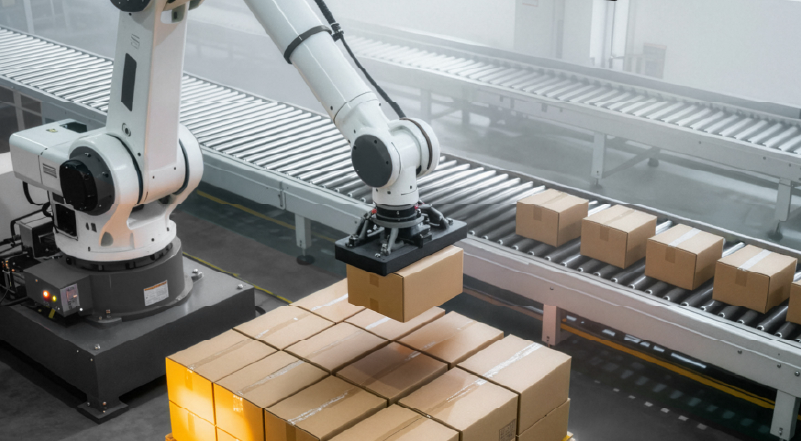
Palletising and depalletising systems use industrial and collaborative robots as well as Gantry systems for handling KLT boxes and crates. The robots palletise or depalletise pallets, transport goods and optimise space utilisation, while collaborative robots enable safe collaboration with operators.

Robotic picking (bin-picking)

Robotic picking uses industrial and collaborative robots equipped with machine vision systems to “bin-pick” – this means picking goods or materials directly from KLT boxes or bins. The robots can identify, locate and grasp desired products, speeding up picking, increasing accuracy and minimising manual intervention by operators.

Picking

The goals for picking in an automated warehouse are maximum speed, minimum error and reduced worker movement. Warehouses therefore follow the “goods-to-person” principle: they are designed to bring the goods to the worker, either directly (e.g. AMRs and cubic systems) or by means of transport systems.


Robotic picking (see the Robotics section) is implemented as a replacement for workers outside an automated warehouse or, for some technologies, directly inside an automated warehouse.

I’m interested
Getting out

Pick-by-scan

Pick-by-scan is a picking method in which the worker picks using a barcode scanner (RF terminal). The system guides the worker to the correct location in the warehouse and after picking the goods, the worker scans the item for confirmation. This checks for accuracy and instantly updates the data in the system. The method reduces errors and increases efficiency over paper picking.

Pick-by-voice

Pick-by-voice is a picking method in which the worker communicates with the system by voice through a headset with a microphone. The system gives instructions (e.g. where to go and how many pieces to pick) and the worker confirms the task by voice response. This leaves the worker’s hands and eyes free, which increases the speed of the work. The method also reduces errors and improves ergonomics compared to conventional picking methods.

Pick-by-light

Pick-by-light is a picking method in which shelves are equipped with light indicators. The system lights up a specific location and displays the number of items to be picked, thus guiding the worker directly. Once the goods have been picked, the worker confirms the operation with a button. The system is very fast and accurate, but requires a high investment in technology.

Loading and unloading

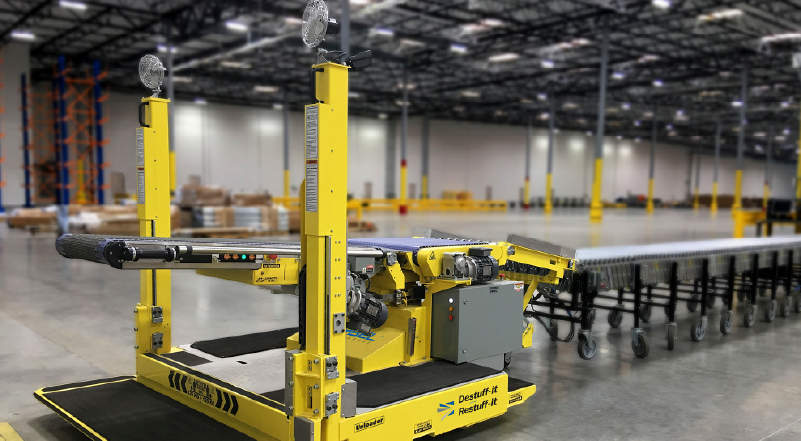
Automatic truck loading and unloading ensures fast and smooth movement of goods between the warehouse and the vehicle. Conveyor systems such as belt, roller or telescopic platforms ensure high performance and a constant transport frequency. Small crates and boxes can be handled by robots inside the truck that automatically unload and position them accurately. This system minimises physical labour and increases the automated warehouse’s efficiency.
I’m interested
Loading and unloading

Robotic handling inside of trucks

Robotic handling inside of trucks is used primarily when unloading small crates or boxes, where robots automatically remove the shipments and precisely place them on conveyors or workstations. It increases the accuracy, safety and efficiency of the operation, especially in automated warehouses.

Conveyor systems

Conveyor systems are used to move goods, pallets or crates between a warehouse and a truck. They can be belt, roller, telescopic or extendable platforms that ensure constant speed and high transport performance. They are reliable and suitable for continuous loading and unloading with minimal physical work.

Quality control

Quality control in intralogistics ensures that goods and packaging meet standards and order requirements. It is carried out during receipt, storage, picking and dispatch and includes visual, quantitative and automated checks. The correct type, quantity and condition of parts, the integrity of packaging and correct labelling are all monitored. The aim is to minimise errors and complaints and ensure a smooth and reliable flow of materials.
I’m interested
Quality control

Quality control of goods, parts and products

Quality control of goods, parts and products in intralogistics consists of verifying the correct type, quantity and condition of items during receipt, storage, picking and dispatch. It is carried out visually, by weighing, or using barcodes, RFID or camera systems. The aim is to ensure that all items meet the required standards and to minimise errors or complaints. This process increases the reliability and efficiency of material flows in the warehouse.

Quality control of packaging

The inspection of packaging in intralogistics consists of verifying its integrity, correct labelling and suitability for handling and storage. Appropriate and sturdy packaging is a key requirement for the use of automated systems, including conveyors and automated warehouses, as it ensures the safe and smooth flow of goods. Inspection is carried out visually, by checking dimensions, by weighing, or using camera systems and code readers. The aim is to minimise damage to goods and handling errors and ensure an efficient automated process.
Add Zebra to your automation solution | Aimtec

Add Zebra to your automation solution

Zebra Technologies provides a broad portfolio of automatic identification products and services. We can help you choose the best technology for you.
Case study:

Automation of a distribution warehouse for promotional textiles

Through the deployment of AutoStore and HaiPick technology, MALFINI expanded its storage capacity to more than 25 million units and increased its shipping speed to as many as 190,000 units per day, with delivery to key markets within 24 hours.

“Achieving your goals always comes first. We work with proven technologies and suppliers – and where the situation requires a specific solution, we keep looking.”


Jiří Žižka
ask-arrows

Jiří Žižka Project Delivery Manager

Jiří Žižka
quote-arrows
quote-dots

Aimtec Insights

Get in touch

Do you have a question? Would you like to see how our solutions work in practice? Daniel will walk you through the specific options for your operation.


Daniel Vopelka Business Development Manager

cta-arrows